
The First Berserker Khazan Bosses: Full Order, Locations, And Fight Guide
The First Berserker Khazan Bosses are the biggest challenge in the game, and they shape the full pace of the story from the first snowy area to the final palace fight. Some players only want the boss’s order. Others want to know which fights are optional, which ones are the hardest, and how to survive the ones that keep killing them. This guide covers all of that clearly. The First Berserker Khazan Bosses are not just names on a list. They are the game’s main progression path, the main gear farming path, and the main reason the combat feels so tense from start to finish.
A lot of players search for the First Berserker Khazan Bosses because they want one simple answer before they push deeper into the game. How many bosses are there, which ones are required, and which fights should you prepare for first? That is what this guide answers. It also gives you a practical look at attack patterns, safe attack windows, phase transition pressure, stamina management, and the kind of boss behaviour that turns a normal fight into a wall. If you keep one thing in mind, make it this. The First Berserker Khazan Bosses reward patience more than panic.
Quick List Of The First Berserker Khazan Bosses In Order
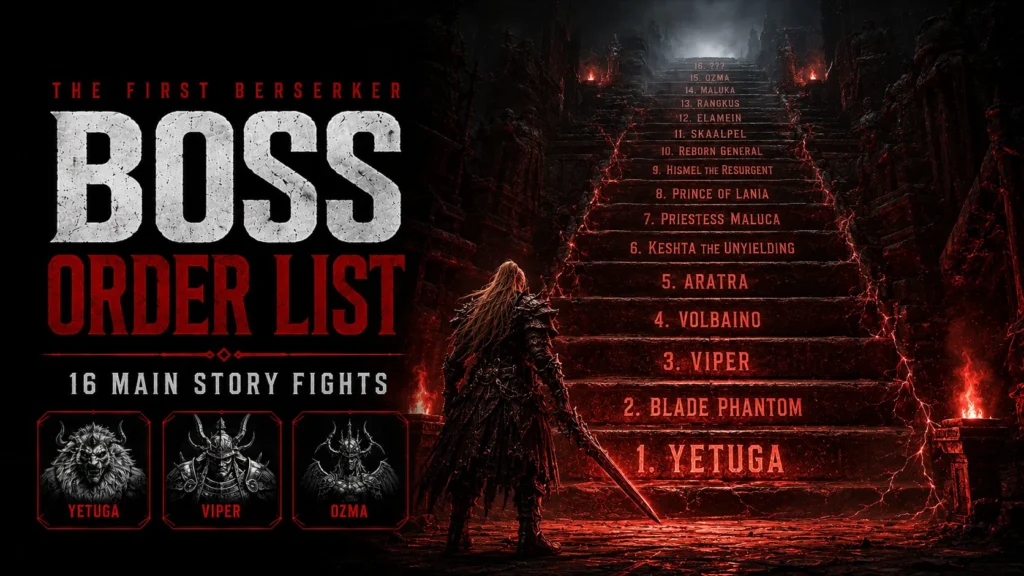
The First Berserker Khazan Bosses in the main story order are Yetuga, Blade Phantom, Viper, Volbaino, Aratra, Rangkus, Maluca, Elamein, Shactuka, Trokka, Bellerian, Skalpel, Princess Ilyna, Hismar, Reese, and Ozma. That is the clean story route, and it gives you the full backbone of the game from start to finish.
This order matters because the First Berserker Khazan Bosses are tied to mission progress. You clear one region, reach the mission ending fight, then move into the next zone with a tougher set of enemies and a stronger boss test. The early fights teach basic timing. The midgame fights raise the pressure. The late fights push your build, your reflexes, and your patience at the same time.
If you are writing down The First Berserker Khazan Bosses for quick reference, think of them as a ladder. Each one prepares you for the next one. That is why the order is useful; the real value lies in understanding what each boss asks of you.
How The First Berserker Khazan Bosses Work
The First Berserker Khazan Bosses are built around stamina, timing, and control. This is not the kind of game where you win by pressing attack over and over. You win by reading patterns, knowing when to guard, knowing when to dodge, and knowing when to back off before your stamina gets too low. That is what makes the fights feel fair, even when they are brutal.
A boss in this game often has one clear rhythm, then a second rhythm after the phase transition. That is why The First Berserker Khazan Bosses can feel easy for ten seconds and then suddenly become dangerous again. The game wants you to adapt in real time. A strong player learns when to use perfect guarding, when to save stamina, and when to wait for the boss to overextend.
Imagine you are in a tough fight and the boss keeps chaining fast attacks. If you panic, you lose the rhythm and get clipped by the next burst attack. If you stay calm, watch the attack pattern, and take only one or two clean hits, the whole fight becomes more manageable. That is the real lesson behind The First Berserker Khazan Bosses. They test discipline as much as damage.
“Full official details on First Berserker Khazan official site.”
Optional Bosses And Side Bosses In The First Berserker Khazan
The First Berserker Khazan Bosses are not limited to the main story. There are optional bosses and side bosses spread across bonus missions, side missions, and extra progression content. These fights matter because they are useful for gear farming, gear sets, and material farming. They also help you learn combat rhythm before the game throws a harder fight at you.
The side content is important because it offers more than just loot. It gives you practice. The First Berserker Khazan Bosses in side missions often remix ideas from the main campaign so that you may face a familiar enemy with a different move set, more pressure, or a stronger arena mechanic. That is where enemy variants become important. You start to see the same kind of threat in a new form.
Here is a simple way to think about the side boss pool.
| Charnak Mountain Range | Keshta the Unyielding, Specter of Bhangau, Bearius | Early practice and easy gear farming |
| Pell Los Plateau | Xaldin, Mutated Xilence, Bringkus, Yeturak, Sergei, Yerid the Completed | Better route control and harder remixed encounters |
| Heart Of Pell Los | Failed Creation, Gwydo, Reaper, Mutated Rosha, Remnant of Elamein, The Ninety Ninth Owl, Tanya | Late game challenge and strong battle rewards |
| Vitalon Capital Of The Empire | Cursed Boris, Netherworld Jocko, Netherworld Tigron, Netherworld Aratra, Gilsan, Specter of Pleuvious | Endgame side content and high pressure fights |
The First Berserker Khazan Bosses in side content are worth doing because they help you grow before the main road gets meaner. A player who skips them may reach the required progression fights underprepared. A player who clears them usually enters the next mission with better tools, better confidence, and better survival strategy.
“Latest boss guides on Game8 Khazan guide.”
Hardest Bosses In The First Berserker Khazan
The First Berserker Khazan Bosses have a few fights that stand out as real trouble spots. Viper is one of the earliest names people remember because it can punish you before you fully settle into the game’s timing. Ozma is the final wall because the last encounter is a long three-phase fight that demands focus from start to finish.
Aratra is another fight that deserves respect. It pushes you to handle weak points, position changes, and a very different combat rhythm. That means your normal habits may not work the same way. If your build is too aggressive, Aratra can expose you fast. If your stamina is too low, the boss can make every mistake feel bigger than it is.
My honest view is that the First Berserker Khazan Bosses are hardest when they combine speed, range, and phase changes in one fight. Viper can feel overwhelming early. Ozma feels punished because the battle lasts so long. Aratra feels hard because it demands clean execution rather than brute force. That mix is exactly why the game stays memorable.
“For RPG boss preparation tips, check our Hardest Boss Clair Obscur guide.”
Best Preparation Tips Before Boss Fights
The First Berserker Khazan Bosses are much easier when you prepare before the fight instead of reacting inside the fight. Start with your gear. Make sure your weapon upgrades are current, your build is not scattered, and your healing setup is ready. If a boss causes poison effect, frost pressure, or chaos ailments, bring the right curing items and do not rely on raw damage alone.
Good preparation also means learning the boss before chasing big damage. Watch the attack patterns for a few seconds. Learn the safe attack windows. Learn when the boss gives you a healing window. If the fight has a burst attack that ends a combo, do not trade hits to keep pressure. That habit causes most of the deaths in the First Berserker Khazan Bosses.
Think about this like a real match where one mistake changes everything. Imagine you are in a fight, you’ve got the boss almost down, and you try to land one extra strike while your stamina is already low. The boss punishes you, your guard breaks, and the whole fight flips. That is why patience matters. The First Berserker Khazan Bosses reward clean decisions more than risky ones.
“For weapon upgrade strategy, check our Path of Exile 2 Weapons guide.”
Can You Replay The First Berserker Khazan Bosses?
The First Berserker Khazan Bosses are not all handled the same way as a simple boss select menu in every game. What matters most is that the game supports postgame challenge content once you finish the campaign. That means players who want more testing still have a path after the first clear.
Replay value matters because the First Berserker Khazan Bosses teach you something new on a second pass. A fight that felt random the first time often starts to make sense once you know the attack pattern and the phase transition timing. That is one reason boss refights and challenge modes stay fun. They let you see how much your skill has improved.
For many players, replaying The First Berserker Khazan Bosses is not about loot only. It is about mastery. You stop asking how to survive and start asking how fast you can control the fight. That shift is one of the best parts of the game.
Boss Fight Strategy By Enemy Type
The First Berserker Khazan Bosses are easier to understand when you group them by enemy type instead of by name alone. Not every boss asks for the same answer. Some punish close-range combat. Some force you to respect ranged pressure. Some rely on status ailments. Some are built around large openings that reward heavy hits.
| Fast Melee Boss | Uses quick chains and short recoveries | Focus on dodge timing and one safe punish |
| Heavy Melee Boss | Hits hard but leaves bigger openings | Use perfect guarding and wait for stamina recovery |
| Ranged Pressure Boss | Keeps distance and controls space | Close the gap carefully and avoid panic movement |
| Status Ailment Boss | Uses poison, frost, or chaos effects | Bring curing tools and play safer than usual |
| Two Phase Fight Boss | Changes speed or damage after phase transition | Reset position and treat phase two like a new fight |
This is the easiest way to improve against the First Berserker Khazan Bosses. Once you know the enemy type, you stop guessing. You begin to see the fight as a set of rules. That is where the game becomes more readable, and the boss stops feeling unfair.
All Main Story Bosses And Their Locations
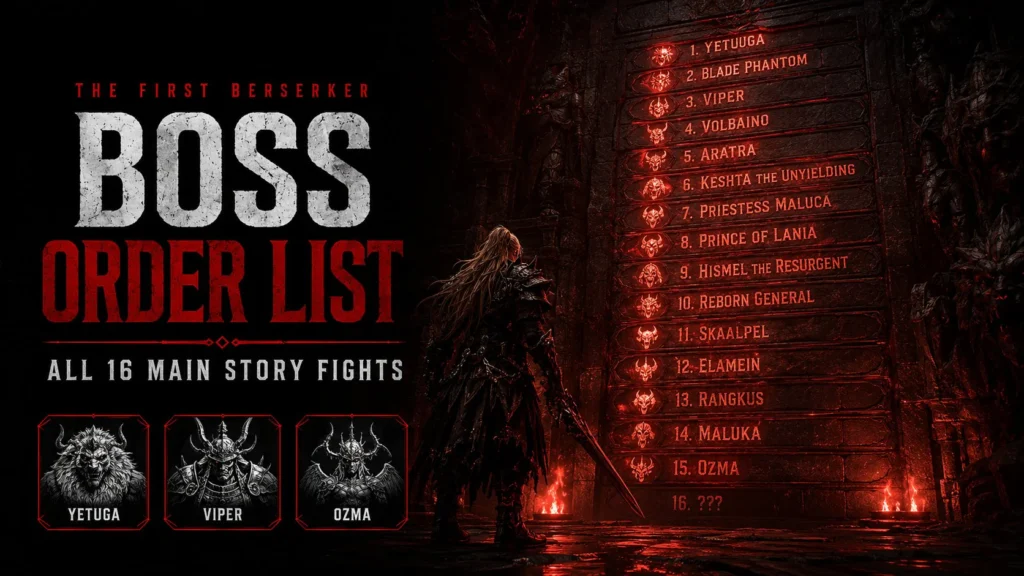
The First Berserker Khazan Bosses in the main story are tied to specific missions and areas, and that makes the path easier to track.
Yetuga appears in Mount Heinmach during Banished Hero. This is the opening test and a good example of how the game introduces pressure early.
Blade Phantom appears in Stormpass during Trials of the Frozen Mountain. This fight teaches you how The First Berserker Khazan Bosses can use speed and space together.
Viper appears in Embars Ruin during Forgotten Location. This is one of the first serious spikes in difficulty.
Volbaino appears in Phraugh Village during the First Act of Revenge. By now, the First Berserker Khazan Bosses are asking for cleaner reaction time and better stamina control.
Aratra appears in Skoffa Cave during Strange Stench. This is one of the fights that can force you to rethink your build preparation.
Rangkus appears in Palemion Citadel during Traitor Revealed. The arena and the pressure both matter here.
Maluca appears in Nadin Quarry during Veiled Knives. This is where the game starts to lean harder into mission-ending fights.
Elamein appears in El Ravaca Village during Devoured Village. The name alone tells you the tone is getting darker, and the fight follows that pattern.
Shactuka appears in Linon Mine during Inconceivable Truth. The game keeps ramping up the difficulty.
Trokka appears in Lake City, Aldevir, during Witch’s Castle. This fight keeps the late-game challenge moving forward.
Bellerian appears in the Raphalan Mountains during the Hermit Mountains. It fits the game’s habit of turning each zone into a test of rhythm.
Skalpel appears in Vaisar Gate during Corruptors’ Fortress. This fight feels like a warning that the endgame is close.
Princess Ilyna appears in Rovelion Imperial Theatre during Strange Melody. It is one of the more memorable The First Berserker Khazan Bosses because the setting and the fight both stand out.
Hismar appears in Capital City Vitalon during the Fall of the Empire. The stakes feel much bigger here, and the pressure shows it.
Reese appears in Great Location during Bloodied Sanctuary. This is one of the final required progression fights before the end.
Ozma appears in the Imperial Palace during Master of Chaos. This is the final encounter, and it is the fight where every lesson from The First Berserker Khazan Bosses gets tested at once.
FAQs About The First Berserker Khazan Bosses
How many First Berserker Khazan Bosses Are There?
There are 16 main story bosses and 22 optional side bosses, which brings the known total to 38. That is why The First Berserker Khazan Bosses feel so large and varied.
What Is The First Berserker Khazan Hardest Boss?
Many players point to Viper or Ozma. Viper is a hard early wall, while Ozma is the hardest late-game test among The First Berserker Khazan Bosses.
Are Optional Bosses Important In The First Berserker Khazan Bosses List?
Yes. Optional fights help with gear farming, material farming, and build preparation. They also make the main path easier to navigate.
Can You Replay The First Berserker Khazan Bosses After Finishing The Game?
The game supports postgame challenge content after the first clear, so yes, there is replay-focused content for players who want more boss time.
Which First Berserker Khazan Bosses Should New Players Fear Most?
Viper, Aratra, and Ozma are the ones that usually cause the most trouble because they push timing, stamina management, and phase transition control.
Do The First Berserker Khazan Bosses Drop Useful Rewards?
Yes. Boss fights are tied to battle rewards, gear sets, and progression upgrades, which makes them important for both power and progress.
Final Thoughts On The First Berserker Khazan Bosses
The First Berserker Khazan Bosses are the main reason the game feels so intense and rewarding. They are not just obstacles. They are the whole structure of the adventure. Once you understand the order, the locations, and the fight style, the game becomes much easier to read and much more fun to master.
The First Berserker Khazan Bosses also work because they respect player growth. A boss that feels impossible at first can become manageable once you improve your dodge timing, guard timing, and stamina management. That is the kind of design players remember.
If you are building a guide, the First Berserker Khazan Bosses deserve a clear structure, a real strategy, and enough detail to help readers survive the next fight. That is what keeps them reading and what makes the article useful.


4 Comments